
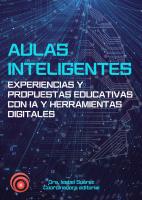
Smart Classrooms: Educational experiences and proposals with AI and digital tools
Synopsis
Smart Classrooms: Educational Experiences and Proposals with AI and Digital Tools is a collective work that invites us to critically rethink education in the context of contemporary digital transformation. The book articulates pedagogical experiences and proposals that conceive artificial intelligence and digital tools as mediations at the service of learning, teacher reflection, and comprehensive training. Through research, situated experiences, and diverse methodological frameworks, the chapters demonstrate how planning, formative research, curriculum, and pedagogical practice can be enriched when technology dialogues with solid ethical, pedagogical, and humanistic principles.
The work stands out for its plurality of voices and contexts, ranging from higher education to primary education, as well as fields such as teacher training, qualitative research, neurodidactics, and medical education. As a whole, the book not only showcases innovative uses of AI, but also problematizes its tensions—authorship, academic citation, ethics, and decision-making—reaffirming that true classroom intelligence lies in educators' ability to design meaningful, reflective, and responsible experiences. In this sense, Smart Classrooms establishes itself as a benchmark for teachers and researchers seeking to integrate technology without sacrificing the deeply human meaning of education.
Chapters
-
Chapter 1: Sharing transdisciplinary knowledge in global contextsThe COIL Project based on the application of Diego Gracia's deliberative reasoning method in various educational settings in Spain and Colombia
-
Chapter 2: Artificial intelligence in professional development for formative research in university facultyA phenomenological–hermeneutic perspective
-
Chapter 3: ChatGPT as a teaching assistant to optimize lesson planningMethodological innovation in smart classrooms
-
Chapter 4: Transforming micro-planning with artificial intelligenceContextualized teaching experiences
-
Chapter 5: Integrated Teaching MethodologyThe Role of the Teacher and AI-Assisted Personalization in Higher Education
-
Chapter 6: Curriculum, teaching practice, and training in digital technologies for teachers
-
Chapter 7: Virtual neurodidactic strategies to enhance linguistic development and reading comprehension in primary education in the Dominican Republic
-
Chapter 8: Artificial Intelligence as an ally in medical educationExperiences in the academic environment
-
Chapter 9: Beyond replacementLevels of AI Integration in a qualitative research methodology course based on the PICRAT framework and Bloom’s Taxonomy
-
Chapter 10: Academic Citation and Generative Artificial IntelligenceChallenges for Research Tutoring in Graduate Education
Downloads
Downloads
Published
Series
Categories
License

This work is licensed under a Creative Commons Attribution-NonCommercial-NoDerivatives 4.0 International License.


